
The SMART Antiviral Prize is focused on identifying safe and effective broad-spectrum small molecules that have the potential to advance into clinical trials and achieve U.S. regulatory approval. The goal of this competition is to advance the development of novel antivirals that strengthen the therapeutic pipeline and address gaps in strategic preparedness in partnership with innovators offering creative solutions.
Submissions are open now through May 11, 2026!
The SMART Antiviral Prize focuses on supporting the development of antivirals with broad-spectrum activity against members of the Togaviridae and/or Flaviviridae families.
There are currently no FDA-approved broad-spectrum antivirals for any viruses within these families—which include dengue, Zika, West Nile, and Chikungunya. These viruses collectively cause millions of infections each year, including increasing numbers of cases in the United States.
The SMART Antiviral Prize is more than a competition – it’s a call to advance bold ideas and move promising science forward.
Participation in the SMART Antiviral Prize is subject to official Terms & Conditions.
The SMART Antiviral Prize is focused on identifying safe and effective broad-spectrum small molecules that have the potential to advance into clinical trials and achieve U.S. regulatory approval. The goal of this competition is to advance the development of novel antivirals that strengthen the therapeutic pipeline and address gaps in strategic preparedness in partnership with innovators offering creative solutions.
The SMART Antiviral Prize is a multi-stage competition designed to move candidates from idea to IND readiness through clear, stage-specific milestones and published evaluation criteria. It begins with a Concept Stage that prioritizes a well-defined technical and development approach (not extensive data), with later stages requiring progressively deeper technical submissions and evidence of broad-spectrum activity and product attributes—while allowing multiple entry points as candidates advance.
Participation in the SMART Antiviral Prize is subject to official Terms & Conditions.
If you or your organization would like to explore collaborations with other innovators for potential joint collaborative applications, please visit the SMART Antiviral Prize Teaming Page.
Have questions about the SMART Antiviral Prize? Join one of our upcoming info sessions to learn more about the challenge, the application process, and what we’re looking for. You’ll also have the opportunity to engage directly with the VITAL team during a live Q&A.
All information provided within is preliminary and subject to change. Specific criteria and requirements are currently being refined. In the event of any inconsistency, the official SMART Antiviral Prize Terms & Conditions supersede this information.
Describe development plans to discover or advance broad-spectrum small molecule antivirals for Flaviviridae and/or Togaviridae families.
Identify at least one promising chemical series with reproducible cell-based antiviral activity and an early SAR that supports rational optimization.
Build an initial “go/no-go” dataset for each series—basic ADME/PK, key developability flags, and early safety/DDI triage—to justify moving into lead optimization.
Optimize potency, selectivity, and exposure to produce a well-characterized lead and backup, with a clear plan to mitigate remaining liabilities.
Demonstrate in vivo proof-of-concept efficacy in a relevant animal model and nominate an IND candidate (and backup where feasible) suitable for IND-enabling studies.
Complete the nonclinical package required for first-in-human dosing, including GLP toxicology/safety pharmacology and definitive ADME/DDI studies, plus manufacturing/CMC readiness (quality, stability, and formulation appropriate for clinical use).
Conduct appropriate FDA interactions and assemble an IND-ready submission package suitable for filing to initiate clinical trials.
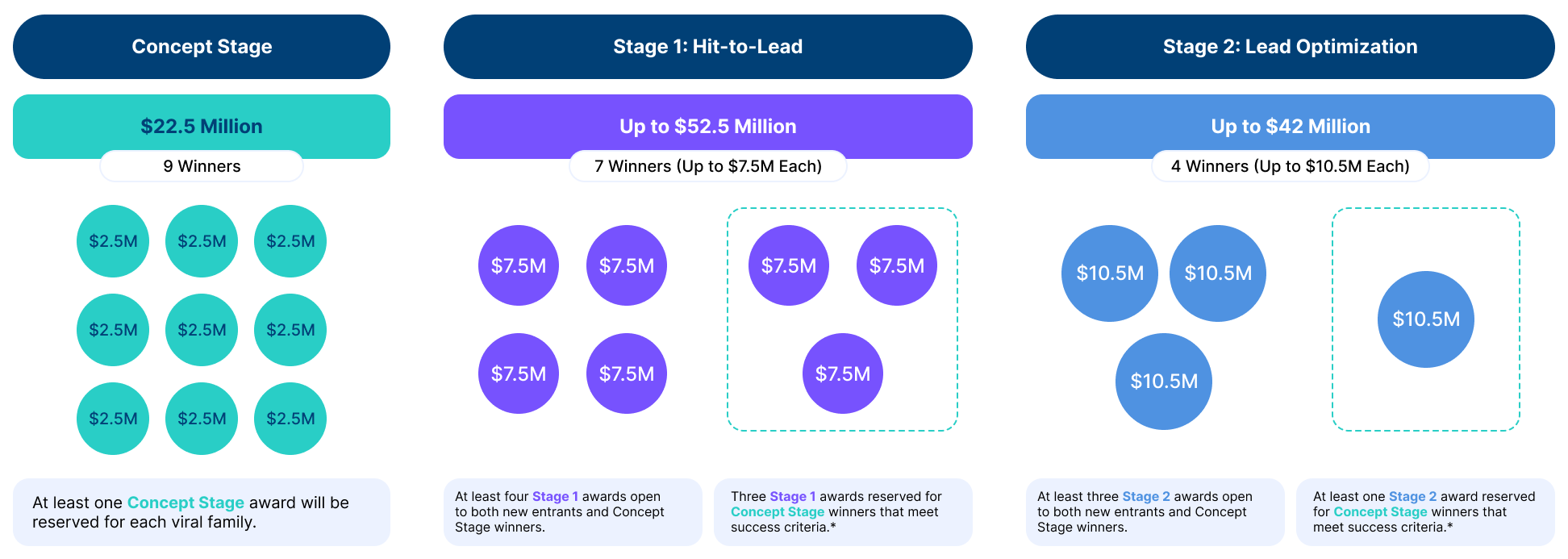
The SMART Antiviral Prize offers up to $100M in awards to support innovators across four progressive stages – from early concept through IND readiness. Each stage builds upon prior success, rewarding the most promising candidates for achieving ambitious yet attainable milestones on an accelerated timeline.
Total Prize Pool
$20M
$36M
TBD
TBD
Number of Prizes
Up to eight – $2.5M each
Up to six – $6M each
At least four
At least two
Stage Launch & Declaration of Intent
Open Feb 2 – May 11, 2026
Anticipated Summer 2026
Anticipated Early 2028
Anticipated Early 2030
The SMART Antiviral Prize fosters the growth of early-stage innovators by providing seed funding at the Concept Stage, and by reserving two awards in Stage 1 for Concept Stage winners. Teams with candidates already in preclinical development can enter Stage 1 without having participated in the Concept Stage.
Awards for Concept Stage
Up to eight awards will be made after a merit-based review of all proposals. Submissions will be reviewed as a batch after the solicitation period is closed. Applications will be accepted starting in early February 2026. Concept Stage award decisions are anticipated in Q3 2026. The evaluation process and accompanying criteria are outlined below.
Awards for Stage 1: Hit-to-Lead
Up to six awards will be made in total. Up to two (2) of the six awards are reserved exclusively for Concept Stage winners that meet the Optimal or Essential Success Criteria within the specified submission window.* All applicants must submit a Declaration of Intent and receive approval before their submissions can be reviewed.
Rolling review (“first-to-finish”). Data packages may be submitted at any time during the submission window (anticipated to open in early 2027). Submissions will be reviewed in the order received, and awards will be made on a first-to-finish basis, subject to validation of the data.
Two success-criteria tracks. Data packages may be submitted against one of two success criteria: Optimal Success Criteria or Essential Success Criteria, as defined in the Target Compound Profile.
*Reserved awards for Concept Stage winners. The two reserved awards are available only to eligible Concept Stage winners and may be earned at any time during the submission window. These reserved awards will be issued to the first two Concept Stage winners whose data packages meet the Optimal Success Criteria. If none of the Concept Stage winners meet the Optimal Success Criteria, the reserved awards will be issued to the first two Concept Stage winners to meet the Essential Success Criteria during the submission window.
The SMART Antiviral Prize uses a two-stage review process:
Stage 1: Written Submission Review
An expert judging panel will review, score, and rank all Concept Stage written submissions using the published evaluation criteria. Scores and rankings will be based solely on the information provided in the written submission at the time of submission.
Stage 2: Virtual Presentations (“Pitch Calls”)
Based on rankings from Stage 1, the highest-scoring applicants will be invited to participate in a virtual presentation (“Pitch Call”) with the judging panel. The Administrator expects to invite fifteen (15) applicants. To support a balanced portfolio, the Prize Administrator intends to invite at least two (2) applicants targeting each prioritized viral family (Togaviridae and Flaviviridae).
Prize Award Recommendations
Following Pitch Calls, judges will submit results—reflecting final scoring and prize recommendations—to Start2 for decision. Consistent with the stated evaluation criteria and eligibility requirements, the final recommendations will support selection of eight (8) winners with at least one (1) winner from each prioritized viral family (Togaviridae and Flaviviridae).
The submissions will be reviewed using the following evaluation criteria.
Scientific rationale and antiviral target strategy
Judges will assess how clearly the submission explains its antiviral concept, including the proposed mechanism of action, relevance to broad-spectrum activity within one or more prioritized viral families, and strength of the supporting evidence (e.g., literature, public data, or preliminary in silico/experimental findings) that the target or pathway is essential, druggable, resistant to development of viral escape, and plausibly conserved across multiple viruses.
Development and regulatory strategy
Judges will consider how well the submission lays out a realistic, coherent path from the current state of the program toward a Phase 1–ready small-molecule antiviral candidate, including key preclinical activities and milestones, anticipated regulatory needs, and a thoughtful approach to identifying and mitigating major technical, regulatory, and operational risks over the anticipated prize stages.
Capabilities, partnerships, and execution feasibility
Judges will evaluate whether the entrant and any proposed partners have the expertise, resources, and collaborations needed to execute the plan, including relevant scientific and development capabilities, access to required infrastructure and IP/freedom to operate, and an overall program management approach that makes timely, high-quality delivery of the proposed work feasible.
In Stage 2 of the evaluation process, in addition to the written submission, judges will consider the following factors during the Pitch Call:
The SMART Antiviral Prize has outlined the set of target criteria for eligible entrants to reach by the end of Stage 1. Applicants applying for Concept Stage funding should design a credible development plan with these milestones in mind to address early risks and reach the project goals within the data submission period.
All information provided within is preliminary and subject to change. Specific criteria and requirements are currently being refined. In the event of any inconsistency, the official SMART Antiviral Prize Terms & Conditions supersede this information.
This document outlines Desired Product Attributes that applicants may find useful when shaping antiviral concepts for submission to the SMART Antiviral Prize. These attributes are provided as a draft and are subject to change as the prize design is further refined.
iPersistent infections caused by Chikungunya lead to prolonged viral presence (up to 28 days) and may need longer duration of treatment for sustained viral clearance.
The SMART Antiviral Prize has outlined the set of target criteria for eligible entrants to reach by the end of Stage 1. Applicants applying for Concept Stage funding should design a credible development plan with these milestones in mind to address early risks and reach the project goals within the data submission period.
All information provided within is preliminary and subject to change. Specific criteria and requirements are currently being refined. In the event of any inconsistency, the official SMART Antiviral Prize Terms & Conditions supersede this information.
Thank you for your interest in the SMART Antiviral Prize. Since the prize challenge is looking for innovators who can accelerate development of broad-spectrum, small molecule antiviral therapies, teaming collaborations between diverse sets of innovators are encouraged to achieve these goals.
If you or your organization would like to explore collaborations with other potential applicants, please complete the form below. After a short vetting process, you will be contacted by VITAL, and your information will be added to the publicly accessible list below.
All information provided within is preliminary and subject to change. Specific criteria and requirements are currently being refined. In the event of any inconsistency, the official SMART Antiviral Prize Terms & Conditions supersede this information.
BARDA currently supports multiple efforts to develop therapeutics against several biological threats. One consistent limitation in current medical countermeasure (MCM) preparedness efforts is the lack of successful processes and approaches available to improve the early-stage pipeline for small molecule therapeutics. This aspect of MCM preparedness is particularly challenging given that traditional approaches have not worked well for these types of therapeutics.
Therefore, the goal of this effort is to identify new technical approaches that can address this critical gap in preparedness. Under this effort, approaches are sought that can produce new, safe, and effective small molecules active against a broad range of viruses within one or more viral families. The SMART Antiviral Prize will be composed of four stages, with success in the final stage culminating in an IND-ready candidate prepared to progress to Phase I clinical trials.
We seek to award new innovators and new breakthrough approaches, while encouraging participation from both traditional and non-traditional innovators in order to expand the pool of creative and feasible solutions. The goals of the SMART Antiviral Prize are to address gaps in the current pipeline of therapeutics that can advance into the clinic, as well as identify promising approaches to small molecule development that could be rapidly applied to future threats.
As outlined in the Program Overview and Rationale section, BARDA recognizes the importance of broad-spectrum small molecule antiviral approaches that strengthen the therapeutic pipeline and address critical preparedness gaps. The prize competition model encourages participation from both traditional and non-traditional innovators, expanding the pool of creative and feasible solutions.
The SMART Antiviral Prize is limited to traditional small molecule drugs—organic compounds with a molecular weight at or below 900 Daltons that can be chemically synthesized or isolated from natural sources (e.g., plants, animals, minerals). The following are not permitted: biologics (including peptide-based products and antibody–drug conjugates) and nucleic acid-based drugs. Nucleotide and nucleoside analogs are allowed and considered traditional small molecule drugs for the purposes of this prize competition.
Proposed antivirals must directly target highly conserved viral factors (direct-acting antivirals) or proviral host factors required for viral entry, replication, or persistence (indirect-acting antivirals). Products without measurable antiviral activity will not be considered. “Measurable antiviral activity” refers to demonstrated inhibition of viral replication or reduction in viral load in relevant in vitro and in vivo models. Products that act solely through immunomodulatory or symptomatic mechanisms without directly impacting the viral lifecycle will not be considered.
No. The focus of this effort is on new approaches that drive development of small molecules with improved performance characteristics. Developers with more advanced products are encouraged to review open solicitations to identify potential opportunities for BARDA funding.
The SMART Antiviral Prize focuses on identifying antivirals with broad-spectrum activity against the Togaviridae and/or Flaviviridae families.
Both viral families are prioritized by the Public Health Emergency Medical Countermeasures Enterprise (PHEMCE) due to their potential to emerge as novel, high-consequence pathogens capable of causing a U.S. public health emergency. In addition, these viral families were selected based on alignment with BARDA’s published Emerging Infectious Diseases (EID) strategy (Johnson et al. 2025) and prioritization frameworks (White et al. 2025; White et al. 2025). Specifically, BARDA’s prioritization framework emphasizes factors such as public health impact, outbreak size and frequency, technical feasibility of development, and readiness of countermeasure approval pathways.
No. Preclinical results are expected to be confirmed using live, non-attenuated viruses or strains, which may include BSL-3 and/or select agents. BSL-4 viruses or strains will not be required due to facility access limitations.
The antiviral candidate should be suitable for treatment of acute, laboratory-confirmed infection caused by viruses within the Flaviviridae and/or Togaviridae families.
Eligibility requirements can be found in the section above. Concept Stage application details can be found on the Prize Details page. There is no minimum Technology Readiness Level requirement.
No. Stages beyond the Concept Stage will be open to previous entrants, prior prize winners, and new entrants.
Yes. An entrant may enter or re-enter the prize competition at any subsequent stage, provided they meet the eligibility criteria for that stage. For Stages 1–3, entrants must also submit and receive approval of a Declaration of Intent to be eligible for prize awards.
Yes. However, an entrant may only be selected as the prime awardee for one award per stage.
Submission review criteria will be published at the opening of each stage. Submission review criteria for the Concept Stage can be found here.
Reporting requirements specific to each prize stage will be released at the opening of each stage. For the Concept Stage, winners will have quarterly meetings with VITAL, in which the winner will provide updates on the following topics as they pertain to the proposal: progress on development toward the goals of the proposal, technical achievements and milestones, technical troubleshooting, risks and mitigation planning, intellectual property, regulatory strategy and planning, changes in personnel and cybersecurity updates. Quarterly meetings will follow a template, which will be provided to the winners.
No.
No. USG employees and support contractors are not eligible to be part of a submission in any capacity – whether as primary submitters, team members, collaborators, advisors, or any other role, and whether paid or unpaid.
This document outlines Desired Product Attributes that applicants may find useful when shaping antiviral concepts for submission to the SMART Antiviral Prize.
The SMART Antiviral Prize has outlined the set of target criteria for potential applicants to reach by the end of Stage 1. See this document for more information.
Did you miss the SMART Antiviral Launch Event? No worries – explore the presentation shared at the SMART Antiviral Prize launch, covering the challenge vision, priorities, and scientific scope.
All information provided within is preliminary and subject to change. Specific criteria and requirements are currently being refined. In the event of any inconsistency, the official SMART Antiviral Prize Terms & Conditions supersede this information.